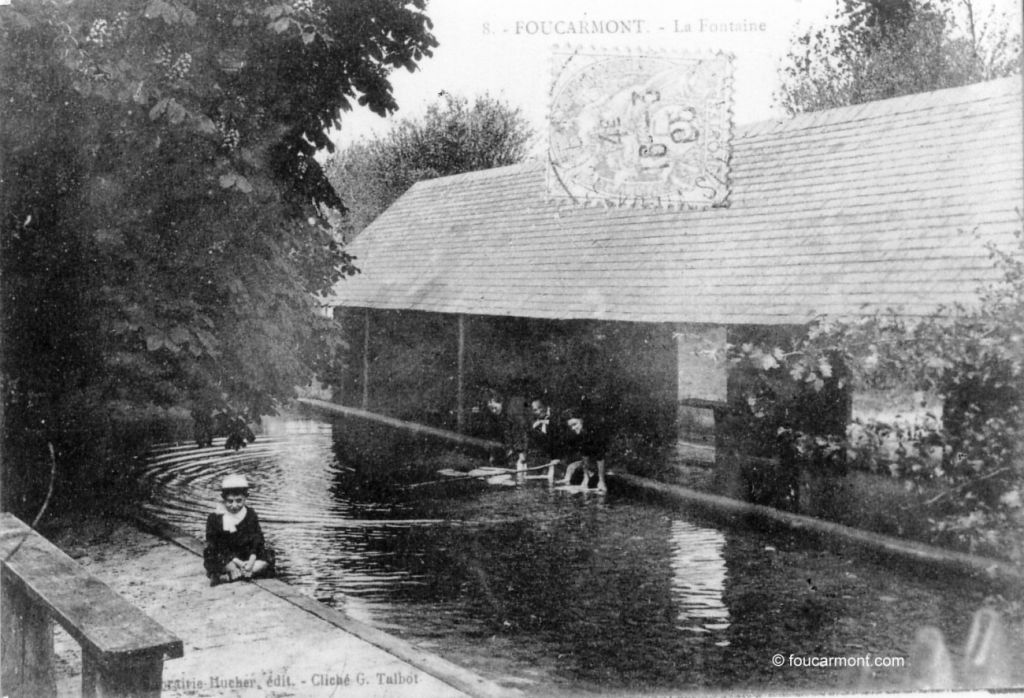
Before we dive into caring for antique French linens, let me tell you about how they were laundered in the days when they were in regular use. Each village along our valley has a wash-house. This small building stands on the river’s edge with one side open to the water. Steps lead down to the river with flat stones lined up.
In the 19th century, these wash-houses were in daily use. Maids and housekeepers came with baskets of linens. They wet the fabric and rubbed it with soap. Then they pounded the sheets and clothes hard. After washing, the linens were left in the flowing river to rinse.
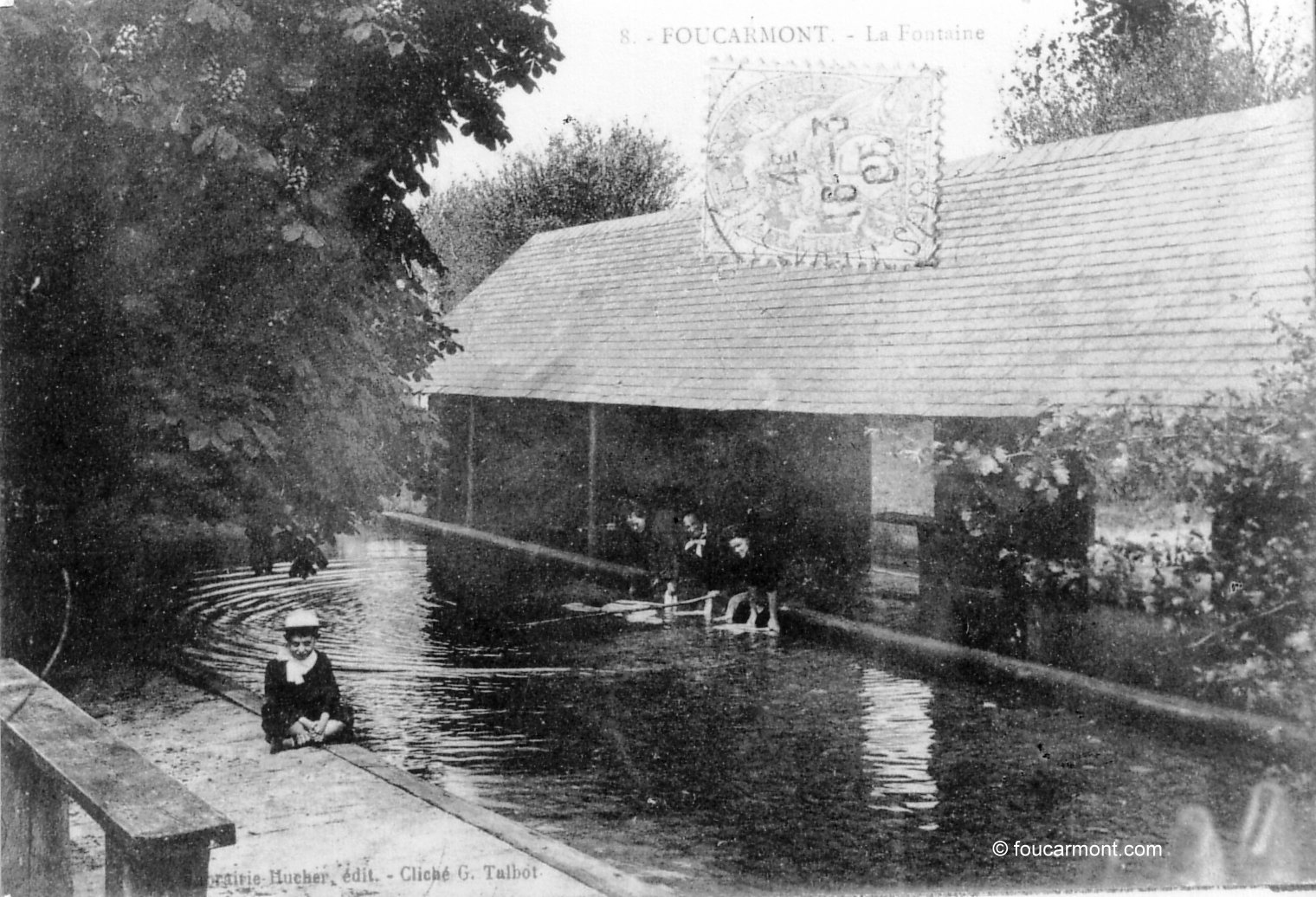
They hauled the very heavy sheets out of the water. Then they twisted them to squeeze out as much water as possible. Once home, the sheets were hung to dry or laid on fresh grass in meadows. The green grass helped whiten the linens in the sun.
Sounds exhausting, doesn’t it?! Today, our lives are much easier. But this story reminds us how strong linen really is.
Here in Normandy, I use linen sheets on all our beds. They are washed regularly, and I have my own way of caring for them. This helps me enjoy their beauty every day.
Washing and drying
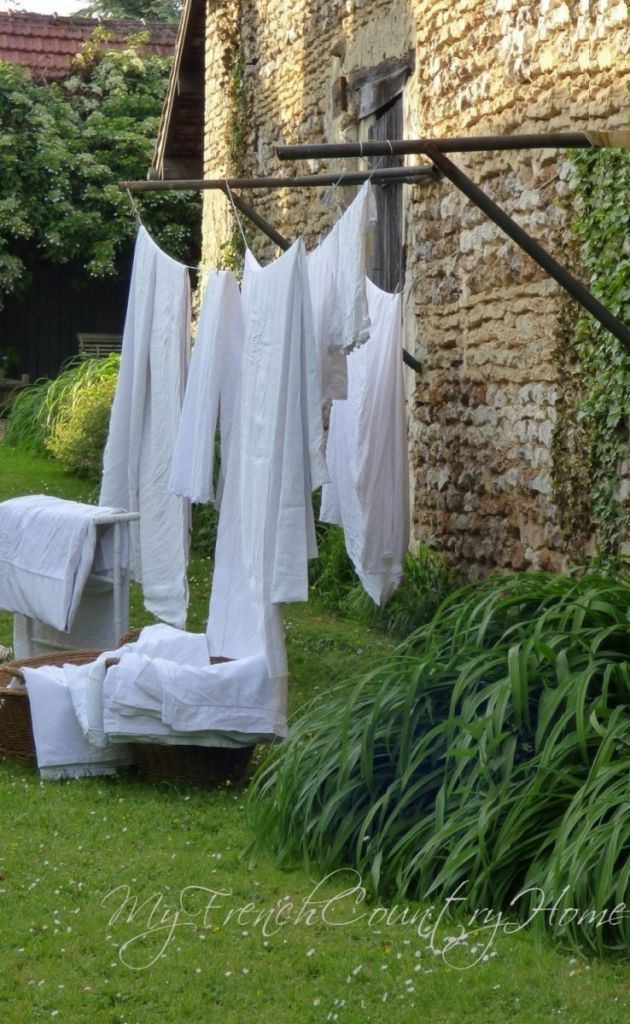
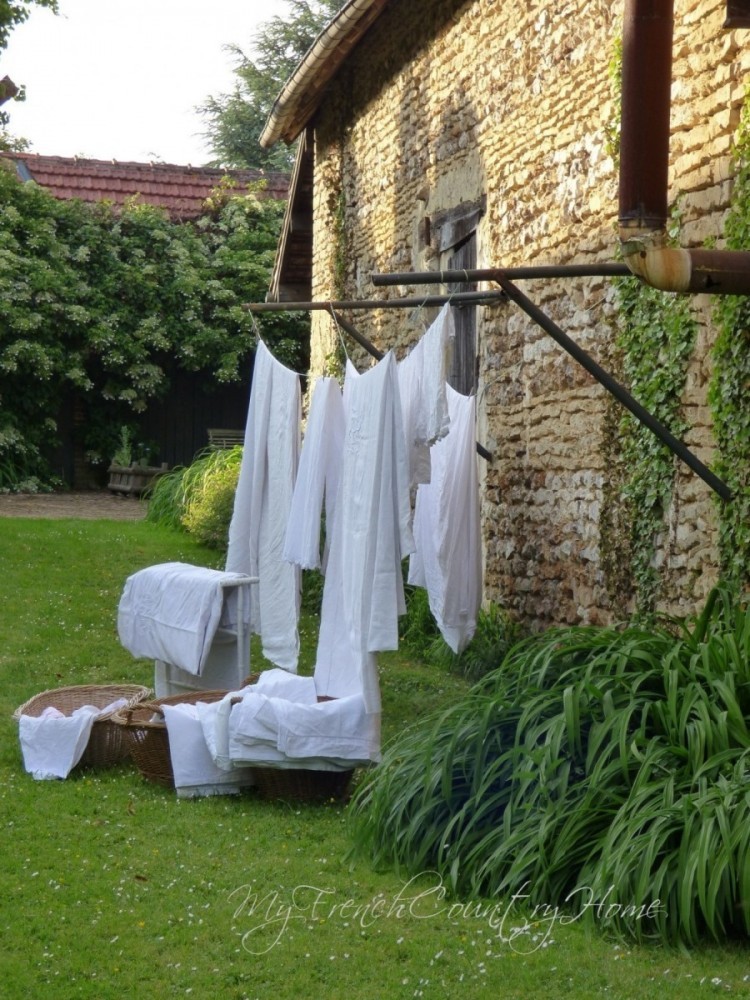
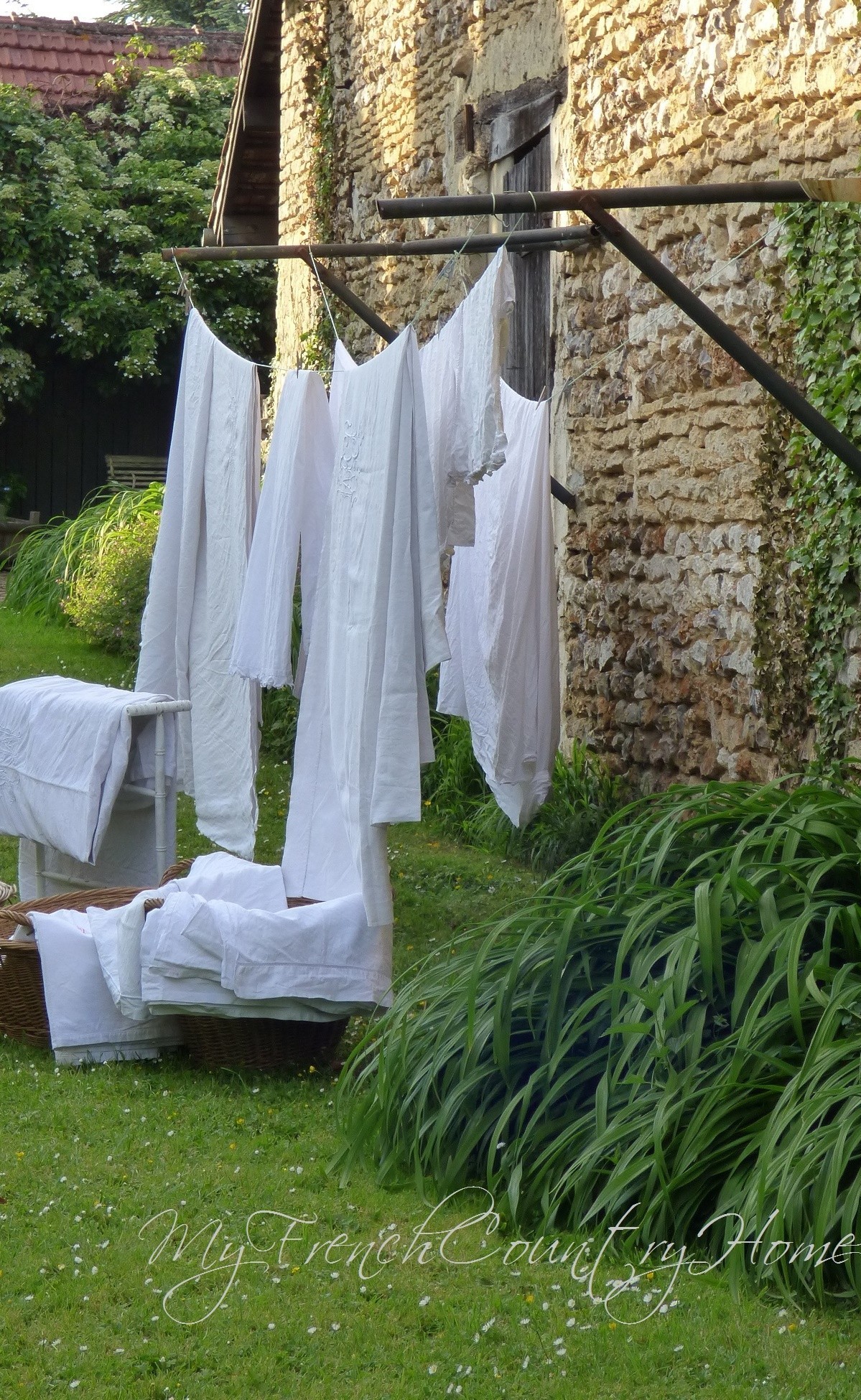
All my sheets are washed on a hot or very hot cycle in the washing machine. They are always hung out to dry on a line behind the barn in our garden. Old sheets are never dried in a tumble dryer. It is impossible to uncrinkle them once they get too dry. Also, I believe dryers damage the fabric fibers.
Nothing beats the fresh, clean smell of sheets dried in the sun.
Ironing
Personally, I like to have my sheets ironed flat. They look better on the bed and store more neatly. Some friends with Aga stoves dry their sheets folded on the warm stove. That works well, but I prefer the crispness of freshly pressed linen.
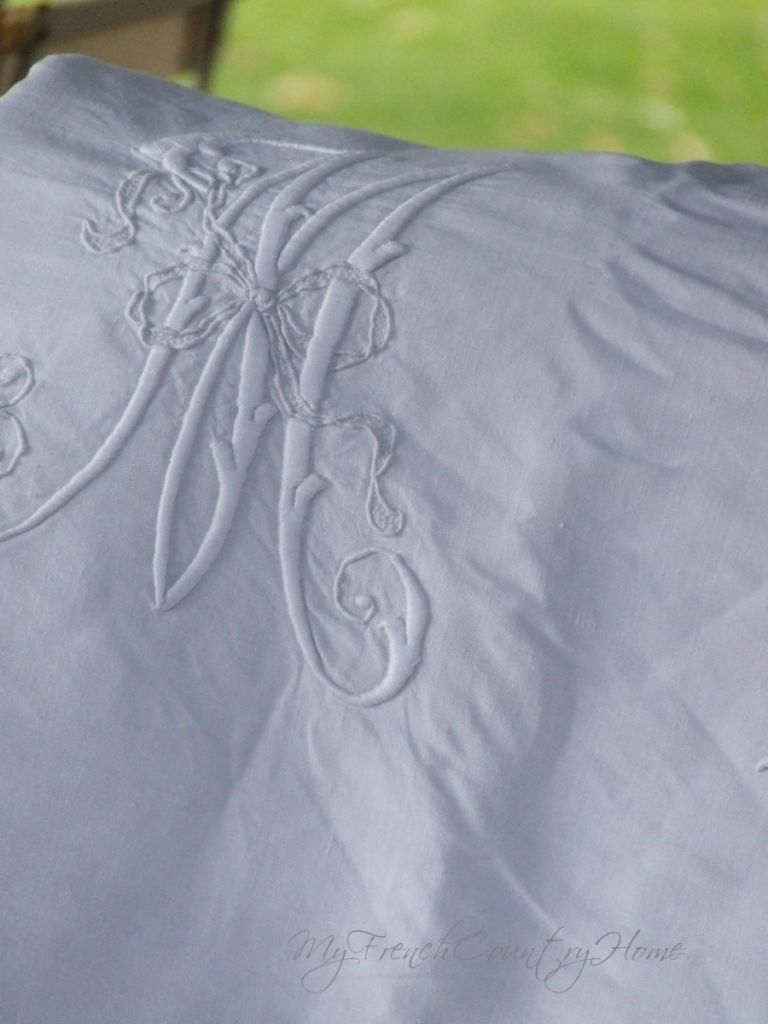
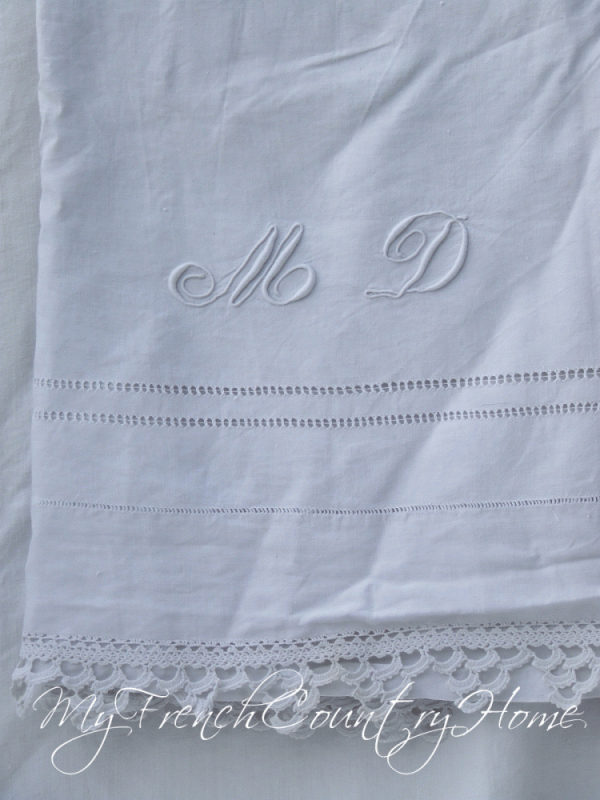
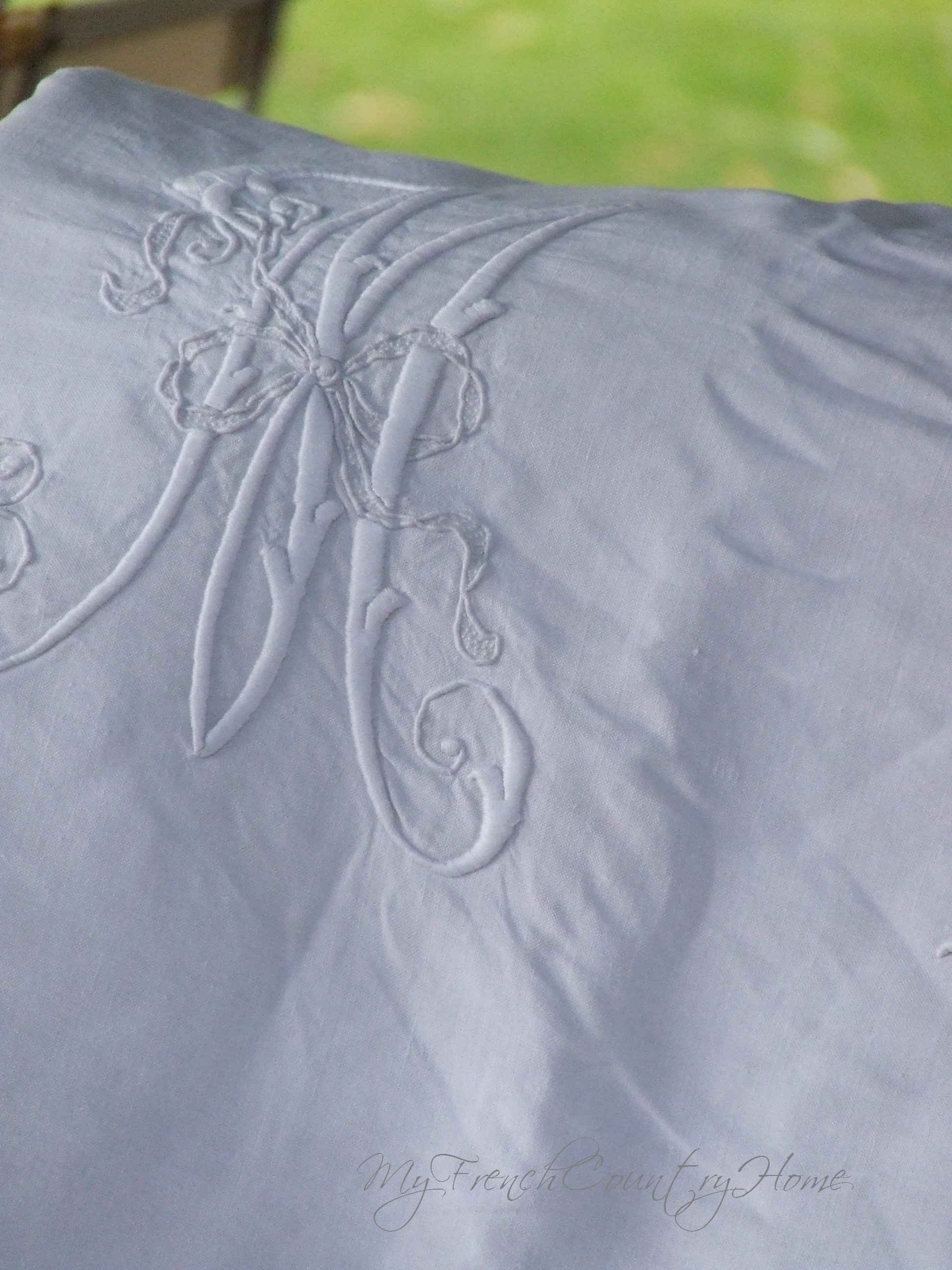
I iron the sheets folded into four layers width-wise. This keeps the embroidery or monogram visible for easy finding. I use a steam iron. In the past, I used a roller press, which I loved. If the sheet is a little damp after ironing, I let it hang folded for a couple of hours. Then it is folded smaller for storage.
Storing
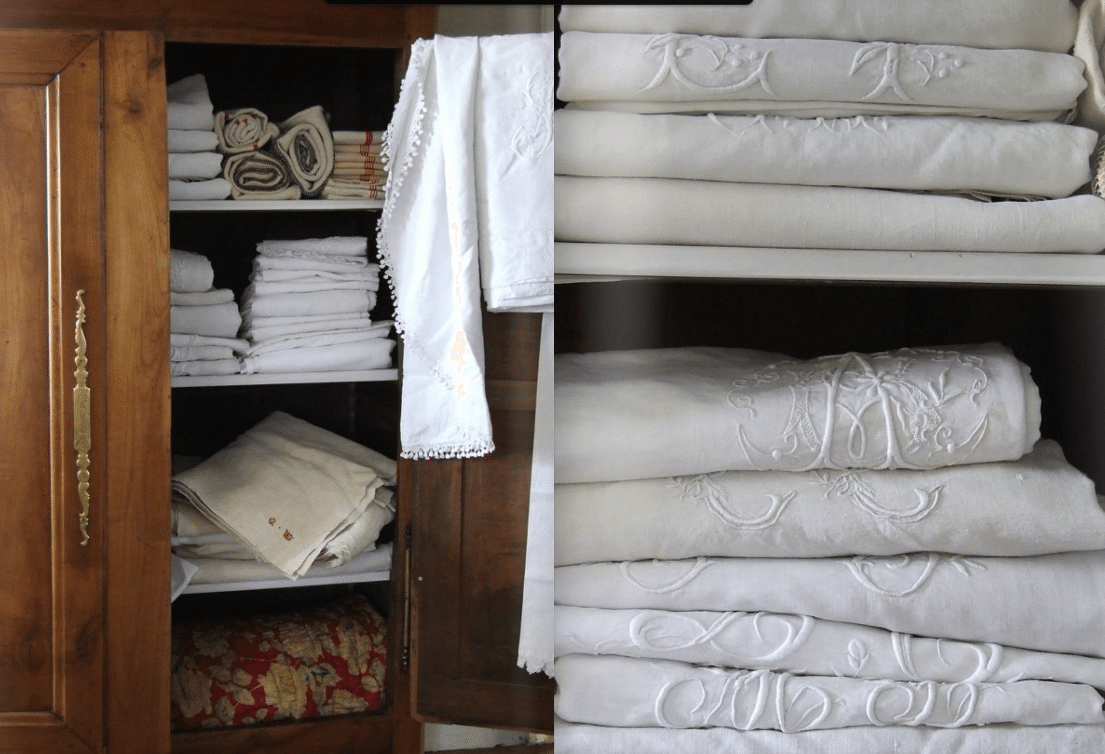
I love seeing an armoire filled with beautiful old sheets. I sort them into plain sheets and embroidered top sheets. The embroidered ones have long turn-backs folded over the duvet when the bed is made.
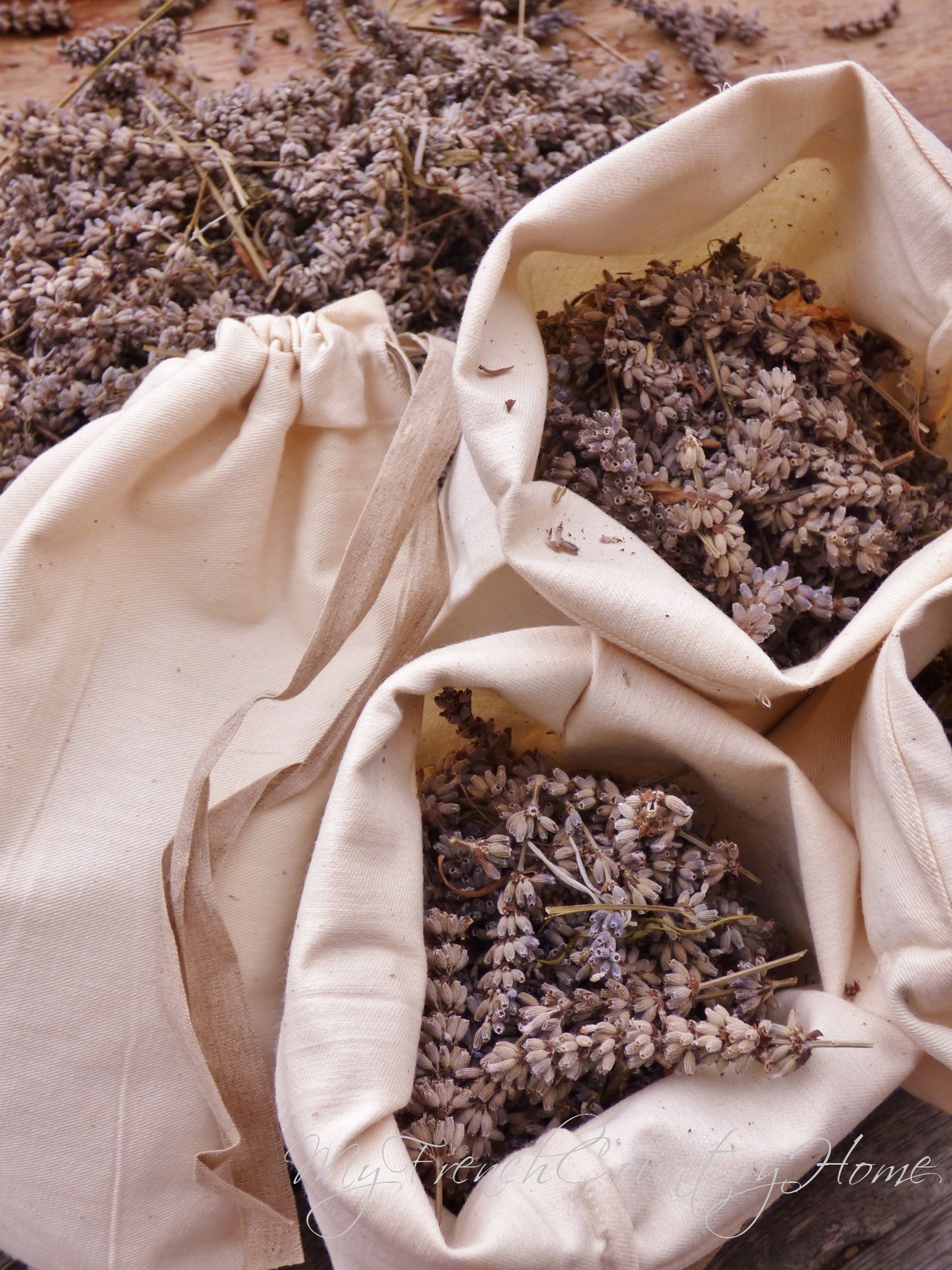
I keep pillow and bolster shams in separate piles. I store them in pairs so I can find matching sets easily. At the back of the shelves, I place bags of lavender. They release a lovely perfume whenever I move the sheets
Stains
As I explained in my last post about buying French antique linens, fold lines are the hardest stains to remove. These happen when sheets have been stored too long without use. I have yet to find a good solution for this.
Old sheets often have small rust spots. If they are far down the sheet and small, I usually ignore them. They do not show when the sheet is in use. For more visible rust, some products can help. You may need to try different solutions depending on where you live. A friend swears by lemon juice and salt left in sunlight.
I rarely use bleach on old linens. It is only a last resort for stubborn dye stains. Bleach is very harsh and should never be used undiluted. Always rinse linens very well afterward.
A tear or a hole
Small tears or holes can be mended with tiny stitches or patched invisibly if you have patience. Sheets worn too thin cannot be fixed. If you buy a worn sheet by mistake, consider cutting it up. Use the good pieces for cushion backs or other sewing projects.
….
Voila! At the end of the day, antique French linens are made to be used and enjoyed. So get them out of your cupboards and onto your beds!
45 comments
I enjoyed this post, Sharon, especially the history of old wash houses in Europe.
As a dealer of antique and vintage linens, my sisters and I work hard to clean up the worst of stains – tea, rust and even shelf stains – with various modern products, along with the old fashioned, tried-and-true lemon and salt. One thing’s for sure – you really cannot beat the fresh smell of linens hung to dry, and stored with lavender – both of which I do.
As for my everyday household sheets, I hang dry my top sheet but machine dry my bottom and, I can affirm, the machine dryer does break down the fabric over time. I also love pressed sheets and did that for a long time, but it became so tedious weekly, and made my neck hurt, even with folding (I tried to keep it at a minimum single fold, as I hoped to avoid pressing creases into the fabric for wear). I continue pressing all the vintage linens for sale. It is almost a project to do batches of old linens – soaking, washing, hanging, pressing, folding, and tagging for sale – most of which goes unnoticed by the customer, I suppose.
I love my European linens I have collected, and those made by nuns in convents are simply the best!
Have a great day.
Rita
I am interested in your cottage but am not able to contact you on your site. Can you please write to me so I can ask some questions of you? Thank you. I love your site!
how can I buy linen sheets here in the US? can they be bought new, or is all linen only available as antique because it is not longer manufactured? How much does is cost, generally?
Merci.
These are not vintage bed linen products but there is a source of good linen bedding on a site called Rough Linen. Some lovely products here. Also you can find antique linen bedding on the
ETSY Site.
I forgot to add that there is a wonderful site in Australia that makes beautiful bed linen products, called CULTIVER. These are not antique but superb quality that just keeps getting better with every wash. The antiques of the future.
For whitening sheets or getting rid of stains and discolouring on any cotton or linen
products my mother’s trick used to be to spread the sheet or the towel on the grass in the sun and keep wetting it. The sun draws out the offending marks. I have done this many times and it works.
Thank you for Helena Voss for these details about purchasing Linen & quality sheets from the US.
I love my old and not so old bedlinens too.The first pieces
I inherited from my mother in law and than stated to collect them purchase them at fleamarkets and at old aunts mother in laws of my girlfriends.You know the guesthouse needs a lot of white linen. Though I try to dry them in the sun it is not so easy in the cold periods of the year.Thank you for mentioning not to machinedry them. Lavender is a must in every armoire or closet in our house.Sending you the last sunshines from the Great Hungarian Plain. Dorka
Beautiful story and the linens are so lovely.
Where can I find good, used French linens here in the United States? I would love to get some for all of our beds! Thank you.
Cindy
Hi Cindy…you might try Restoration Hardware online or bricks and mortar across the US..cheers
Sharon these are all wonderful tips for keeping beautiful linens.
I love seeing them all folded and stacked in your armoire!!
Xoxo
Karena
The Arts by Karena
Featuring India Hicks!
I too would love to know where to buy antique French linens? Would you be able to help me search for a site?
I love old linens + especially sheets xxpeggybraswelldesign.com
But how do you keep them so white? I struggle with that with my regular sheets. We have hard water here, but we have a water softener in our home, so that shouldn’t be a problem.
I’d also like to know the secret to keeping natural fiber clothing and sheets white, and warding off that awful yellowed look. Any tips?
I’m on the hunt for some lovely linen sheets. Thank you for the care tips!
I have had excellent luck removing fold stains and other stains on my vintage linens using OxiClean, followed by drying them in the bright California sunshine. You can get OxiClean as an additive to your normal linen laundry detergent or you can buy it already incorporated into Arm & Hammer detergent. I have used both with great success.
I hang my head in shame because I am too lazy to iron my linens and just call it the Shabby Chic look. 😮
I live in France and have these old linens also, and recommend using oxalic acid in water, a pretty strong solution, to remove rust stains. The oxalic acid reacts with the iron in the rust — which is of course what it is, oxidized iron. It doesn’t hurt the fabric. I make a saturate solution with boiling water — meaning I use as much oxalic acid as will dissolve — then put it on the stains with a q-tip. As it cools you can use it, but as it cools off the crystals of acid precipitate out, and you need to microwave it (!) to heat it up again so it will work. Also recommended is soaking a discolored sheet for several days in sodium bicarbonate, which will often take out stains and discoloration. There are e-bay and etsy sellers who deal in these precious sheets, as well as other antique french linen items.
Bonnie in Languedoc
US bedding is slightly different in size from UK or French bedding — and we’re so spoiled by pre-made sheets of a certain size. Is there a particular way to measure to be sure the linen sheet you’re buying is large enough?
I really loved the story. I bought some linen sheets from WestElm in the U.S., but then found Rough Linen, on Facebook, roughlinen.com and will possible buy my next pair from her. She is from the UK I believe, but lives in California and the sheets are made in the U.S. The ones I got from West Elm were unfortunately from China. Ugh!
you revived lovely memories from my youth in Luxembourg…. the women socialised at the washhouse while working hard , the children used to play around them , enjoying nature and water … sometimes lending a helping hand ..
I enjoy your amazing blog …. thank you !
Sharon- When a houseguest (ahem) accidentally drips candle wax on a vintage table linen- what do you recommend? I am certain you have first hand experience handling such a thing…. Lol! I Love the vintage linens we brought back and Tom keeps asking me when we get to sleep on them. I’m saving them for when we officially move into our renovated master bedroom in the farmhouse. XO to you! Sarah
Love old French linens but hate doing laundry/ironing so I will not be doing all that to have them!!!
Ah, don’t be too cross with your ‘houseguest’ Sarah, it happens so easily to drip wax on a cloth …. if the cloth is a dark colour then I’m afraid I have no magic solution because in my experience the darker wax stain just never goes.
If the cloth is white then I would first of all put the cloth in the fridge or freeze and chip off as much cold wax as possible, then iron the cloth between layers of kitchen paper to soak out the residue and then wash on a very hot wash. The mark shouldn’t show after that.
speak soon
xox
Sarah:
We had a real candle chandelier for years and here is my solution. I always burned white or ivory candles – so don’t know if this would work for a colored candle.
Put the item with the wax on it in the freezer for over night. Next day, place a couple of layers of paper towel under the item on the ironing board. Then place a layer of paper towel directly on the spot on top of the wax. With the iron on a medium heat place directly over the paper towel and hold the iron in place for a few seconds, not to long as to scorch the item. The wax will melt and the paper towels will absorb the wax. Repeat if necessary. Do this with a dry iron – not steam iron.
Good luck – I have had very good success with this method.
One of the biggest regrets my mom had about her life was that she never used the beautifully embroidered table cloths that her Danish mother had made. Before she died, it was a word of advice that my children would have family memories that included all this beautiful handmade ( Mom was very talented and productive too when it came to this ) items. ‘Even if it gets a stain, who cares?’
So I am. ( but I still remove certain table linens if we are have a meal with tomato sauce) perhaps a hard habit to break after all, we do what we’ve seen done not necessarily what we were told to do.
Thank you, as always, for another great post!!
Lise-Lotte
Where can I find linen sheets handmade by nuns?
Ann p.
Sharon, I will be in the south of France in May next year and would love to know which is the best market to source antique linen? In Australia we have little opportunity to find antique linens. Love your site. Janine
I just watched an old film of a village showing the women washing their laundry at the lavoir. I cannot imagine the back breaking work of that daily chore! I have only one very rough linen sheet that I bought in a brocante a few years ago. Very thick, often repaired (beautifully) with a perfect handseam down the center. After seeing that film, and thinking about how heavy that sheet would be to wash and haul, I appreciate my sheet even more. I can’t wait to return next summer to buy some more!
oh, and I never iron this sheet. It is very rough heavy linen (not the lovely fine linen with embroidery) and comes out of the dryer soft and beautiful. It also gets bleached occasionally, with no ill effect.
Hi Sharon,
Lovely post. I would love to buy some antique linen one day but in Adelaide the supply is limited. Perhaps the next time I’m in France. But I’ve been so intrigued with your reference to linen over the years that about a year ago I bought some “new” bed linen from a place called Provincial Living in Australia. I guess Provincial Living source their linen from China and it wouldn’t be anywhere near the quality of the linen woven on hand looms. However, my question is the care instructions for the linen is to wash in cold water. I notice you recommend hot water. I would prefer to wash in hot water as I think it would be far more hygienic. My question is, would even mass produced linen be okay to wash in hot water? Kind regards, Sandra
Also a generous sprinkle of talcum powder on and below the paper towel as you iron with a medium hot iron helps to absorb the wax. Repeat several times and then launder to get rid of the wax stain.
Beautiful linens are a favourite of mine and I can smell the freshness from your post 😉
Many congratulations, Sharon on your book…I’ve just ordered my copy!
Catherine
https://catherinerobinsoncashmere.com/blog/
I look forward to beginning my day with your amazing site and a cup of coffee. In New Orleans we have a long summer and plenty of sunshine so my linens are always thrown across my side fence after washing. They stay so white. Appreciate all of your wonderful tips and your stories. Warm regards, Del
Hi Sharon~I just water colored a pair of old pillow cases in a pale brown zebra. It was a risk, but I do like them!
I deliberately bought and planted French Lavender this past spring. It is so beautiful, and has blossomed bountifully. The smell is absolute heaven! Now, I am going to be sewing up some of those bags you displayed, and loading them with my perfect lavender blossoms! Next spring, I am ripping out the azaleas and planting French Lavender in their place!
Thanks for such an informative article.
Thanks for another great blog, Sharon!
*Did you receive my email?
Hello Sharon
What a lovely post, and one close to many of our hearts as beautiful linens are something we all like. I have some inherited embroidered bedlinen, and then newer pieces I like to mix together.
For treating rust stains, apply lemon juice mix with salt, and leave outside….it must be a sunny day.. the stain will be gone in a few hours
For the lady who asked about candle wax…if you are in the uk, we have a product called Mr Muscle ( use the spray kitchen cleaner ) dampen the stain, spray and rub like mad.
The candle stain will go, and if you wash and rinse soon after, the linen item will come to no harm ..I promise! ( It also works on things like grease and oil splashes from cooking)
I hope the sun is still shining for you
Sally
xx
I bought a stack of lovely linen napkins at an antique shop in Summerland, California. They were seriously discounted because of small rust stains. Lemon juice and sun took the stains out and they have never returned.
FYI – Chlorophyll does NOT contribute to whitening. It is the Ultra Violet light from the sun that does the job. Same reason that line-dried laundry is whiter and cleaner smelling than laundry from a dryer. BTW , Hydrogen Peroxide is a MUCH better whitener and disinfectant than bleach. Hydrogen Peroxide is also much more environmentally safe, won’t damage your fabrics like bleach does and leaves no chlorine smell. Hydrogen Peroxide breaks down into pure, clean oxygen and water while Bleach breaks down into salt water and chlorine gas. The main reason we use bleach in the US rather than Hydrogen Peroxide is that Clorox was made from salt water extracted from the Oakland Bay. You can thank American advertising for pushing Clorox bleach on us!
This is probably my favorite post of yours, besides any pictures of your dogs. I can tell that a lot of thought and work went into this post. Thank you, Sharon!!!
Believe it or not, but I also had the same problem when I bought my house. My friends advised me to get in touch with biodegradable pressure washer soap and detergent. Therefore, it helps to do the cleaning regularly and then you will have no problems. I think it would be reasonable as each normal person wants to live in the clean house.
[…] weekend, I’ll be sharing my favorite tips for caring for antique linens. Until then, thank you for reading—you’re the […]
Delicate fabrics need careful handling and proper guidance to stay in good condition. Tips and product recommendations found on homeaglow reviews make caring for antique French linens much easier. Advice from the site can help prevent damage, maintain fabric quality, and extend the life of treasured pieces, making it a useful resource for textile enthusiasts.